Your Kid Just Got Smarter at a Theme Park (And You Didn't Even Notice)
Here's something nobody tells you before your first visit to La Poland Park: you're going to come home with a kid who knows things. Not in a worksheet-and-quiz way. In the kind of way that sticks — where they bring it up at dinner a week later, or notice something in a book at school and say, hey, that's like what we saw at the park.
That's not an accident. It's baked into the design. But because it's wrapped inside great food, live music, and the kind of joy that makes kids forget they're anywhere near anything educational, parents often don't clock it until the drive home.
Let's unpack what's actually happening.
Language Lives Here — And Kids Absorb It Fast
You don't need to speak a word of Polish to visit La Poland Park. But by the time most families are halfway through their day, the kids have already picked up a handful of words without trying.
It's the signage, the music, the performers who toss out a dzień dobry with a grin, the food menus with pronunciations printed right there. Young children — especially under ten — are in what linguists sometimes call a sensitive period for language acquisition. Their brains are genuinely primed to grab onto new sounds and patterns. When those sounds come attached to something delightful (a pieróg, a folk dance, a friendly character), the association is even stronger.
Parents regularly report their kids asking how to say things in Polish on the way home, or practicing words in the car. That's not just cute. That's early exposure to a second language happening naturally, in context — the most effective way it can happen.
History That Doesn't Feel Like History
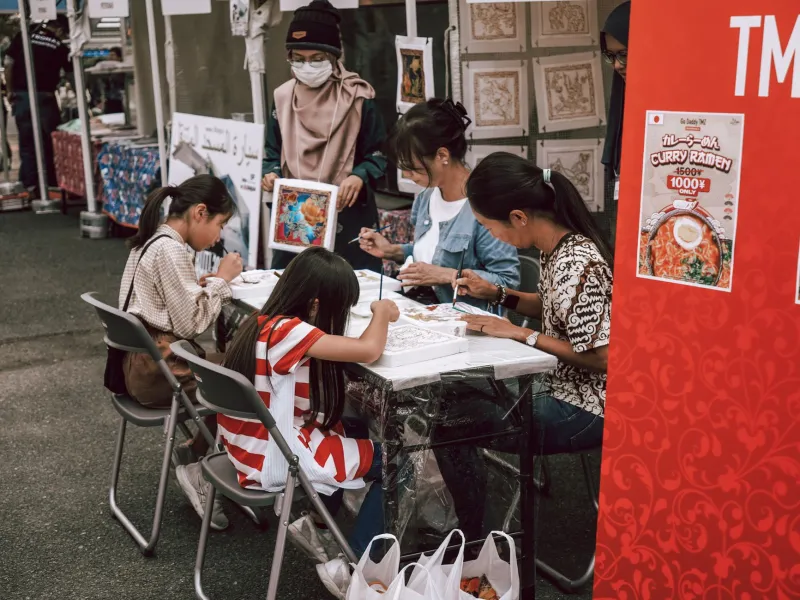
Most kids, if you told them they were about to learn about Polish harvest traditions or Central European folk culture, would zone out immediately. But when that same content is delivered through a costumed storyteller in a reconstructed village, or through a hands-on craft station, or through watching a real demonstration of traditional techniques — suddenly they're completely absorbed.
La Poland Park leans hard into experiential learning without ever labeling it that way. Kids aren't passive receivers of information here. They're participants. They're touching things, tasting things, watching things get made in front of them. That kind of multi-sensory engagement is exactly what educators mean when they talk about embodied learning — and research consistently shows it leads to far better retention than passive instruction.
Ask a kid who visited the park two months ago what they remember. Chances are they'll describe something they did or saw happen, not something they read on a placard.
The Social-Emotional Stuff Is Real, Too
This is the one that surprises parents most.
La Poland Park is a space where kids regularly encounter people who are different from them — different backgrounds, different ages, different ways of celebrating and eating and moving through the world. For many American kids, especially those growing up in fairly homogenous communities, that kind of exposure is genuinely rare.
And it's not just exposure. It's positive exposure. The associations being built here are warmth, celebration, delicious food, music, laughter. When a child's first meaningful encounter with a culture different from their own happens in a context of joy, that shapes how they relate to difference for a long time.
Psychologists who study cultural empathy point to exactly this kind of early positive contact as one of the most powerful predictors of open-mindedness in adolescence and adulthood. Your kid learning to appreciate kielbasa and a polka beat might sound trivial. The underlying skill being built is anything but.
Curiosity Gets Rewarded Here
One of the quieter things La Poland Park does well is make curiosity feel safe and fun. Kids who ask questions — of performers, of food vendors, of park guides — get real answers delivered with enthusiasm. Nobody's too busy. Nobody makes a child feel dumb for not knowing something.
That might sound like a small thing. But for a lot of kids, especially those who've been made to feel embarrassed for not knowing something in a classroom, it's actually significant. La Poland Park becomes a place where not knowing something is the beginning of a fun conversation, not a source of shame.
Parents have described watching shy kids blossom over the course of a single afternoon — asking questions, engaging with performers, getting excited about things they'd never encountered before. The park's scale and warmth make that possible in a way that bigger, louder, more overwhelming venues simply don't.
Cultural Literacy: The Long Game
Here's the thing about cultural literacy — it's not a skill you can download. It builds slowly, through accumulated experiences, stories, and encounters. Every time a child visits a place like La Poland Park and comes away with a genuine felt sense of another culture's traditions, food, music, and history, they're adding another layer to that foundation.
In a world where global fluency is increasingly valuable — socially, professionally, and personally — kids who grow up with genuine curiosity about cultures beyond their own have a real advantage. Not because they went to some elite educational program. Because somebody took them somewhere interesting when they were young.
The Best Part? They Had No Idea
Ask most kids who've visited La Poland Park what they learned that day, and they'll probably talk about the food. Maybe the dancing. Maybe a funny moment with a costumed character.
They won't say, I developed cross-cultural empathy and expanded my linguistic exposure. They'll say, it was so fun, can we go back?
And that's exactly the point. The education at La Poland Park isn't something you sit through. It's something you live — for a day, in a place that makes the whole world feel a little bigger and a little more worth being curious about.
That's the kind of learning that follows kids home. And honestly? It follows parents home too.